


Absorbent materials


Lesson details
Learning outcome
I can investigate which materials are absorbent and explain how suitable they are for different uses.
Key learning points
- The properties of materials make them suitable or unsuitable for particular uses.
- Being absorbent is one such property of some materials.
- If a material is absorbent, it soaks up something, often a liquid such as water.
- Some materials are absorbent, and this makes them suitable for certain uses.
- Scientists test materials to find out which are absorbent and which are not.
Keywords
Material - A material is what an object is made from. An object can be made from more than one material.
Suitable - Someone or something that is suitable for a particular purpose or occasion is considered right or acceptable for it.
Properties - The describing words we use for a material are called its properties.
Absorbent - Absorbent materials soak up other materials.
Investigate - When scientists investigate they are trying to find out what happens when something is changed.
Common misconception
In comparing the extent of a given property in two materials, pupils may rely purely on observation, rather than on active testing.
Provide opportunities to test different materials and observe what happens.
Teacher tip
Provide a variety of materials so pupils can explore absorbancy. Use scenarios, such as choosing a material to clean up a spilt drink, to provide a real-life context for the learning. See video to demonstrate specific aspects of working scientifically linked to the content of this lesson.

Equipment
See additional materials for further guidance.

Content guidance
Risk assessment required - equipment
Exploration of objects

Supervision
Adult supervision required

Licence

Lesson video
Loading...
Prior knowledge starter quiz
6 Questions
Q1.What is the name of the planet that we live on?
Q2.Some materials can harm our planet when they are made. Which word means the same as harm?
Q3.Which of these materials causes little or no harm to our planet?
Q4.What does suitable mean when talking about materials?
Q5.Which of the following are properties of materials?
Q6.Where do these materials come from?

a tree
a rock
oil, natural gas or coal
a plant
Assessment exit quiz
6 Questions
Q1.Why is glass a suitable material for a window?
Q2.Which of these is a property of materials?
Q3.Which of these statements is true?
Q4.Which objects need to be made with absorbent materials?
Q5.How could a scientist investigate whether a material is absorbent?
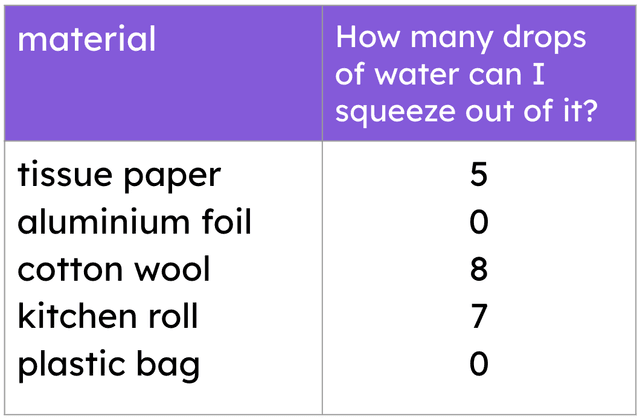
Q6.These are the results of an investigation into whether materials are absorbent. Which materials are absorbent?
To help you plan your 2 science lesson on: Absorbent materials, download all teaching resources for free and adapt to suit your pupils' needs...
To help you plan your 2 science lesson on: Absorbent materials, download all teaching resources for free and adapt to suit your pupils' needs.
The starter quiz will activate and check your pupils' prior knowledge, with versions available both with and without answers in PDF format.
We use learning cycles to break down learning into key concepts or ideas linked to the learning outcome. Each learning cycle features explanations with checks for understanding and practice tasks with feedback. All of this is found in our slide decks, ready for you to download and edit. The practice tasks are also available as printable worksheets and some lessons have additional materials with extra material you might need for teaching the lesson.
The assessment exit quiz will test your pupils' understanding of the key learning points.
Our video is a tool for planning, showing how other teachers might teach the lesson, offering helpful tips, modelled explanations and inspiration for your own delivery in the classroom. Plus, you can set it as homework or revision for pupils and keep their learning on track by sharing an online pupil version of this lesson.
Explore more key stage 1 science lessons from the Uses of everyday materials unit, dive into the full primary science curriculum, or learn more about lesson planning.